Choosing a back-end stack for your web project
For most business web apps and APIs, Node.js with TypeScript is the safe default. Python, .NET, PHP, Java and Go each win in specific cases. A side-by-side comparison on hiring, ecosystem, performance and upkeep.
On this page
My default for a new business web application or API is Node.js with TypeScript. Python wins when the project is mostly data or machine learning, .NET when you already run on Microsoft, PHP when you're extending an existing PHP system, Java when your organisation already runs on the JVM, and Go for high-throughput network services built by a team that knows it. The rest of this post shows the comparison behind that verdict.
It's for founders and managers who've been handed a technology choice in a proposal and want to know whether it's sensible. It's not a benchmark article. For business software, the language rarely decides whether a project succeeds; whether you can hire people to maintain it in five years often does.
Our interest, up front: Cloudgramam builds web applications and APIs in Node.js, ASP.NET Core and PHP, so those three are the ones I can speak to from daily work. The Python, Java and Go notes come from their official documentation. Hosting is billed to you by your provider; we charge only for our work. Support dates and survey figures were checked on 16 November 2026.
How do the main back-end options compare?
The six common choices differ less in what they can build than in who you can hire, how long each release is supported and what kind of work they're quickest at. Here they are side by side.
| Option | Hiring signal (survey use) | Support window per release | Best performance fit | Wins when |
|---|---|---|---|---|
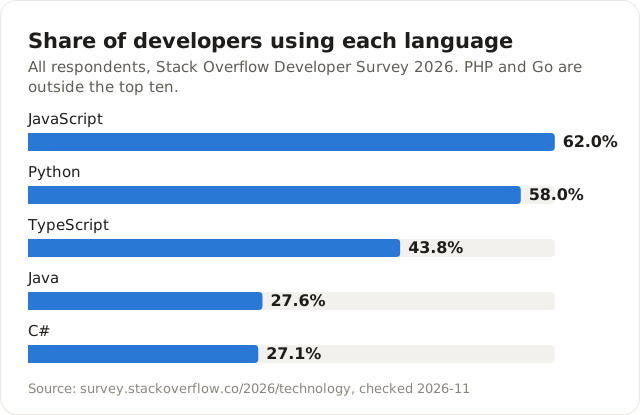
| Node.js with TypeScript | JavaScript 62.0%, TypeScript 43.8% | LTS about 30 months in total | APIs, real-time features, many small requests | One team builds browser and server; web apps and APIs |
| Python | 58.0% | Five years | Data processing, machine learning work | The product is built around data or models |
| PHP | Not in the top-ten chart | Four years (two active, two security) | Page-based sites and CMS work | Extending WordPress or Laravel systems you already run |
| .NET (C#) | C# 27.1% | LTS three years, STS two years | Large business apps, heavy Microsoft integration | You run on Microsoft 365, Entra ID and Azure |
| Java | 27.6% | Depends on your JDK vendor | Large, long-lived enterprise systems | Your organisation already runs on the JVM |
| Go | Not in the top-ten chart | Until two newer major releases exist | High-throughput network services | A team that knows Go builds infrastructure-style services |
The hiring column is the share of all respondents to the Stack Overflow Developer Survey 2026 who reported using the language; PHP and Go don't appear in its top-ten chart. Treat it as a rough signal of how many people know a language worldwide, not as hiring data for your city.
Why is Node.js with TypeScript my default?
Because one language covers the browser, the server and, with React Native, the mobile app, so a small team can work across all three. The 2026 Stack Overflow survey puts JavaScript at the top of its most-used list for the 12th year in a row, which keeps the hiring pool wide.
TypeScript is the part I won't skip. Plain JavaScript lets a renamed field break three screens without warning; TypeScript catches that at build time, and that matters most two years in, when the original developers have moved on. Node.js suits APIs, dashboards, portals and real-time features such as chat or live order tracking.
Its weak spot is heavy CPU work on a single request, like large report generation or image processing. Those jobs belong in a background queue or a separate service. On upkeep, Node.js LTS releases typically get critical fixes for about 30 months in total, and the project says every major version will move to LTS starting with Node.js 27 (Node.js releases). Currently v22, v24 and v26 are LTS. That means planning a runtime upgrade every couple of years, which our Node.js development work includes.
When does Python win?
Python wins when the product's value is in data: analysis, forecasting, machine learning or document processing. Its scientific and data libraries are where much of that field works, so you'd be fighting the current to use anything else for that core.
Each Python release is supported for five years (Python versions), the longest window here, and 3.15 came out on 9 October 2026. For a plain business web app with no data science in it, I don't think Python beats Node.js enough to justify a second language if your front end is already JavaScript. A common and sensible split is a Node.js or .NET main app with a small Python service for the data-heavy part.
Is PHP still a reasonable choice?
Yes, for the right project. PHP runs a great many existing sites, every WordPress site among them, hosting for it is cheap and widely available, and Laravel is a well-organised framework for business apps. If you already run WordPress or a Laravel system, adding to it in PHP is usually the cheaper path.
The catch is upkeep. Each PHP branch gets two years of active support and two more of security fixes only (PHP supported versions). PHP 8.2's security support ends on 31 December 2026, so a site still on 8.2 should be upgraded now. For a site stuck on an unsupported version, the fix is usually an upgrade, not a rewrite, and that's regular work in our PHP and Laravel service.
When is .NET the better fit?
.NET is the better fit when your company lives in Microsoft: staff sign in with Entra ID, files are in SharePoint, and hosting is on Azure. ASP.NET Core works closely with those, and C# is a strict, well-tooled language that holds up in big codebases.
Microsoft's support policy gives Long Term Support releases three years and Standard Term Support releases two (.NET support policy). Right now .NET 10 (LTS) and .NET 11 (STS) are both supported to 14 November 2028, and .NET 8 and 9 went out of support on 10 November 2026. If you have a .NET 8 app, it needs upgrading. Our ASP.NET Core development page covers those upgrades. In our own Node.js service notes we say the same thing: for heavy integration with Microsoft systems, ASP.NET Core can be the better choice.
When do Java or Go make sense?
Java makes sense when your organisation already has Java systems, Java developers and a process for running them. It's built for large, long-lived systems, and in that setting a new service in Java is the low-risk choice. For a small company starting fresh, it's usually more ceremony than the project needs. Its support dates depend on which JDK vendor you use, so check that vendor's roadmap before you commit.
Go suits network services that handle many requests with little memory, such as gateways, proxies and internal tools for infrastructure. Its policy is short: each major release is supported until there are two newer major releases, and Go 1.27.0 came out on 19 August 2026 (Go release history). The language changes slowly, which helps upkeep. The risk for a business is hiring: if the one person who knows Go leaves, you need another.
What matters more than the language?
Three things matter more in practice: whether you can hire for it locally, whether the team keeps it on a supported version, and whether the code is written to be read by someone new. A well-kept PHP app beats a neglected Go app every time.
When a proposal names a stack, ask the team why, and what they'd pick if they couldn't use it. A good answer mentions your existing systems and your hiring, and not only speed. Then check that the plan includes runtime upgrades as regular work. Every option in the table has an end date on each release.
The language is one decision among many in a custom build. The custom software development guide covers scope, cost, contracts and handover, and if you're still deciding whether you need custom code at all, start with custom website or a website builder.