Mobile app development cost in India: what drives it
Two app costs are fixed and public: Apple's 99 USD a year and Google's US$25 once. Everything else is hours times a rate. Here is what drives the hours, with a worked estimate you can rerun with your own quote.
On this page
- Does building for both iOS and Android double the cost?
- Which features add the most hours?
- How much do integrations change the estimate?
- What do Apple and Google take from app revenue?
- What does a worked estimate look like?
- Why do two quotes for the same app differ so much?
- What does an app cost to keep running each year?
- Which hidden delay costs money before launch?
Two numbers in a mobile app budget are fixed and public. Apple charges 99 USD per membership year, or the local-currency equivalent where available, for the Apple Developer Program. Google charges a US$25 one-time registration fee for a Play Console account. Everything else in the cost of a mobile app built in India is hours multiplied by a rate, and the hours come from a short list of drivers: platforms, features, integrations, design, testing and the upkeep that starts the day you launch.
This is for founders and managers getting their first app quotes, or comparing two quotes that look nothing alike. It won't give you a market price, because I don't think one honest number exists. It gives you the drivers and a method to check any quote against.
Does building for both iOS and Android double the cost?
Not with a cross-platform framework. React Native or Flutter lets one codebase serve both platforms, so the second platform adds testing, store setup and some device-specific work rather than a second build.
Native Swift and Kotlin apps are two codebases, and close to two builds. I'd only recommend that when the app leans hard on device features like background location, Bluetooth hardware or widgets. For most business apps, such as ordering, booking, field reports or customer accounts, cross-platform is the better spend. If your web team already writes TypeScript, React Native lets them share some code and knowledge with the app.
Which features add the most hours?
Features that need a server add the most, because each one is built twice: once in the app and once in the back end and admin panel. A screen that only shows information is cheap; a screen that changes data someone else sees is not.
The usual big-ticket items are sign-in with several methods, offline use with sync, live updates such as order tracking or chat, payments, role-based access for staff, and an admin panel your team uses every day. Offline sync is the one people underestimate most. Making the app work without signal is easy; deciding what happens when two people edited the same record offline is where the hours go.
How much do integrations change the estimate?
Integrations are the least predictable line in any app quote, because the hours depend on the other system's API, not yours. A payment gateway with good documentation is quick. An older ERP with no API can mean building a small middle service just to read from it.
Ask each team which integrations they've priced, and how. "ERP integration: 40 hours" means nothing unless you both agree whether that's a nightly import or a live two-way sync.
What do Apple and Google take from app revenue?
Only revenue from digital goods sold inside the app is charged a commission. If your app sells physical goods or real-world services, such as deliveries, repairs or appointments, neither store takes a cut of those payments.
Apple's guidelines say physical goods and services consumed outside the app must use purchase methods other than in-app purchase (App Store Review Guideline 3.1.3(e)), and Google's Payments policy exempts physical goods and services from Play billing. For digital goods the rates are:
- Apple: 30% on digital goods and services, 15% if you're in the App Store Small Business Program (up to 1 million USD in proceeds in the prior calendar year, or new to the store), and 15% for qualifying subscriptions. Apple notes different rates may apply in Brazil, the EU, Japan, the Netherlands, Russia and South Korea.
- Google Play: 15% on the first US$1M of revenue each year and 30% above that, with 15% on auto-renewing subscriptions, for markets outside Australia, the EEA, Japan, the UK and the US, which includes India, per its service fees page.
That matters for the business model more than for the build cost. A subscription app at 15% and a delivery app at 0% are very different businesses.
What does a worked estimate look like?
Here's an illustrative one: a cross-platform booking app for a service business, with customer sign-in, a service list, booking with online payment, push reminders, and an admin panel. Every number below is a made-up input to show the method, not a quote and not a market rate.
Before the numbers, our interest: Cloudgramam builds iOS and Android apps for clients, so we're one of the teams you might be comparing. Store memberships, hosting and payment fees go to Apple, Google and the providers in your own accounts; we charge only for the work. Fees here were checked on Apple's and Google's pages on 16 November 2026.
| Line | Example hours | What it covers |
|---|---|---|
| Discovery and prototype | 40 | Workshops, written scope, clickable prototype |
| Design | 80 | Key screens, design system, accessibility checks |
| App build (React Native) | 300 | Screens, sign-in, booking flow, push reminders |
| Back end and admin panel | 200 | API, database, staff admin screens |
| Payment gateway integration | 40 | Checkout, refunds, webhooks |
| Testing on real devices | 80 | Old and new phones on both platforms |
| Store release | 24 | Listings, privacy forms, review submissions |
| Project management | 60 | Planning, demos, reporting |
| Total | 824 |
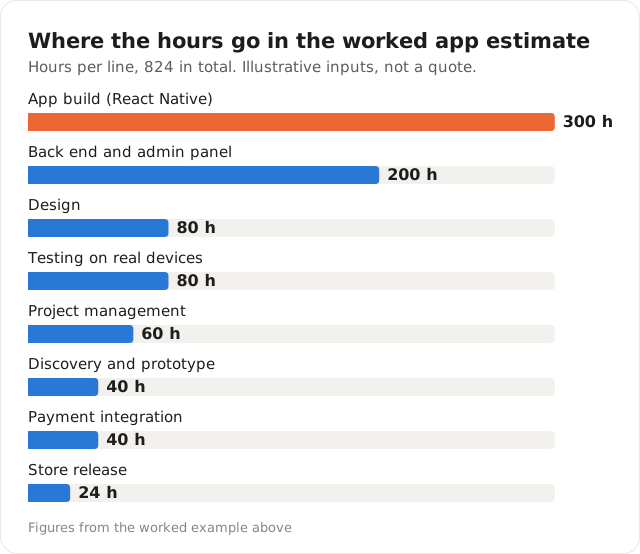
The app screens and the back end together are 500 of the 824 hours; a quote missing the back-end line is pricing a smaller app.
Now pick an example rate. To keep the arithmetic easy, say ₹1,000 an hour. That's a round number chosen for this sum, nothing more. The build comes to 824 × ₹1,000 = ₹8,24,000. If your quote uses a different rate, multiply by that instead; if it shows different hours, the gaps between the two tables are the questions to ask.
Add the fixed fees: 99 USD a year to Apple (or local currency), US$25 once to Google. Then hosting, push notification and SMS services at whatever your providers charge.
Why do two quotes for the same app differ so much?
Usually because the teams priced different apps. One quote includes the admin panel and real-device testing; the other assumes you'll manage bookings in a spreadsheet and test it yourself.
Put both quotes into the table above, line by line. In my experience the missing lines explain most of the gap: no back end, no project management, no store release, or design limited to a template. A low quote with those lines missing isn't cheaper. It's a smaller app.
What does an app cost to keep running each year?
Every app needs yearly work just to stay in the stores, because Apple and Google raise their minimum requirements every year. Budget hours per month for it from the start.
Two current examples. Since 28 April 2026, apps uploaded to App Store Connect must be built with Xcode 26 or later using an iOS 26 SDK (Apple upcoming requirements). From 31 August 2026, new apps and updates on Google Play must target Android 16, API level 36, with an extension to 1 November 2026 available on request (Android target API requirements). Each of these is a rebuild, a round of fixes for whatever broke, and a retest. Then there are your own fixes and small features, plus security updates to the back end. Take an illustrative 16 hours a month for upkeep: at the same example rate, that's 16 × ₹1,000 × 12 = ₹1,92,000 a year.
Which hidden delay costs money before launch?
Account setup. Apple asks organisations for a D-U-N-S Number and a working website on their own domain before it accepts the enrolment (Apple enrolment requirements). Google requires personal accounts created after 13 November 2023 to run a closed test with at least 12 testers opted in for 14 continuous days before production access (Play testing requirements).
I tell every client to open both accounts in the company's name in week one, not the week before launch. A finished app waiting on paperwork still costs you, because the team is on the clock and your launch date slips.
For the bigger picture of scoping, contracts and ownership, read the custom software development guide. If you'd like a second opinion on a quote, or want this table filled in for your own app, our mobile app development team can do that after a short discovery.