What is a good cost per lead? 2026 benchmarks by industry
Industry averages say what other advertisers paid, not what you can afford. WordStream's 2026 Google Ads benchmarks, four common myths about them, and how to set your own target.

On this page
$66.69 is the average Google Ads cost per lead in WordStream's 2026 report, across the search campaigns it studied, ranging from $26.84 in arts and entertainment to $131.63 for attorneys and legal services. A good cost per lead for you, though, is one your business can afford, given how many leads become customers and what a customer is worth. Use benchmarks as a sense check, then set your own target from your own numbers.
This is for owners and marketers deciding whether their ad results are good, or setting a target for a new campaign. Below are the benchmark figures, four myths I hear about them, and the method I use instead.
What do the 2026 benchmarks say?
Across all industries in the sample, the average cost per lead was $66.69 with an average conversion rate of 8.18%. Selected figures from WordStream's Google Ads Benchmarks 2026 (last updated 16 September 2026):
| Industry | Average cost per lead | Average conversion rate |
|---|---|---|
| All industries | $66.69 | 8.18% |
| Attorneys & legal services | $131.63 | 5.55% |
| Furniture | $106.70 | 2.99% |
| Real estate | $102.51 | 3.70% |
| Business services | $93.69 | 4.85% |
| Home & home improvement | $90.92 | 8.05% |
| Education & instruction | $77.48 | 13.14% |
| Finance & insurance | $74.44 | 2.64% |
| Dentists & dental services | $72.97 | 10.67% |
| Physicians & surgeons | $40.04 | 12.43% |
| Restaurants & food | $30.57 | 8.05% |
| Arts & entertainment | $26.84 | 5.91% |
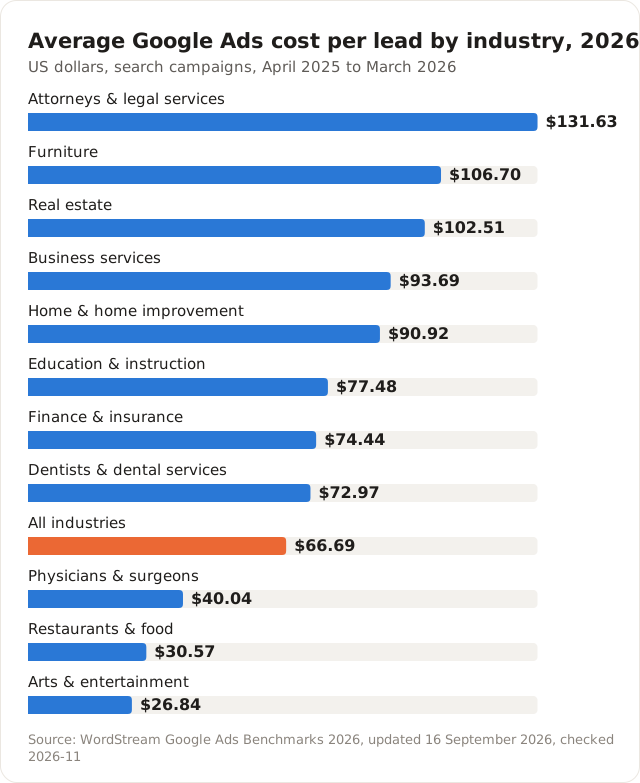
Legal leads cost about five times arts and entertainment leads; the spread matters more than the average.
Is WordStream's average a worldwide figure?
No. Treat it as mostly US search campaigns, because that's what the sample is.
The myth is that $66.69 describes Google Ads everywhere. The report says it looked at over 13,000 search advertising campaigns across 23 industries, running between April 2025 and March 2026, in Google Ads and Microsoft Ads. The campaigns come from the clients of WordStream's sister company LocaliQ, a US business, and the page we read doesn't break the figures down by country. They're also limited to search ads, so Meta, Performance Max and Display aren't in these numbers.
For anyone outside the US, click prices vary widely between countries and even between cities in one country. A dental clinic in a smaller city may pay far less per click than the table suggests; a law firm in a capital city may pay more. The table tells you the shape (legal is expensive, restaurants are cheap), not your number.
Should you aim for your industry's average cost per lead?
No. The average is what other advertisers paid; your target should come from what a lead is worth to you.
The myth goes like this: dentists average $72.97, so a clinic paying $90 is overpaying and one paying $60 is doing well. But the clinic at $90 might be selling implants worth many times a check-up, while the one at $60 might be filling a free check-up offer nobody books. The definition of a lead matters just as much. A benchmark that counts any form fill can't be compared with your cost per qualified lead, and a free consultation brings cheaper leads than a "request a quote" form for a large project.
Is a lower cost per lead always better?
No. Cheaper leads often become customers less often, and cost per customer is the number that pays the bills.
Imagine an accounting firm running two Google Search campaigns. Campaign A, targeting "free tax advice" style searches, costs $28 per lead. Campaign B, targeting "accountant for small business" searches, costs $85 per lead. The owner wants to move budget to A.
The CRM tells a different story. Of A's 50 leads last quarter, 2 became clients. Of B's 30 leads, 6 did. A cost $1,400 in ads for 2 clients, $700 each. B cost $2,550 for 6, $425 each. B is the cheaper campaign where it counts.
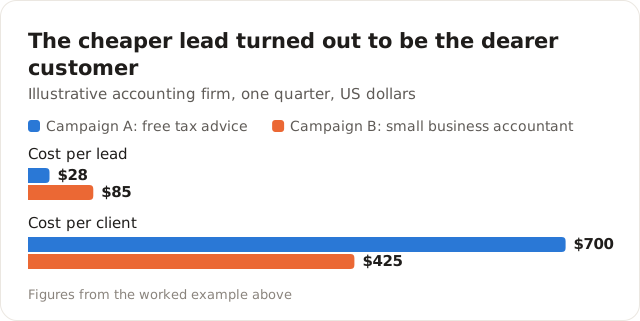
That's why I compare campaigns on cost per customer, or cost per qualified lead, and never on cost per lead alone. It's also why the CRM outcome should go back to Google, so its bidding sees the same thing you do; offline conversion import covers how.
Does being above the benchmark mean the ads are the problem?
Not on its own. A benchmark can flag that something is badly off, but it can't tell you what.
If your cost per lead is three times your industry's average with no obvious reason, such as a pricier market or a bigger-ticket offer, look into it. But the cause is often off the ad account: a landing page that doesn't match the ad, a form asking for too much, or slow follow-up that lets leads go cold. Why ads "don't work" covers the page side, and the speed to lead playbook covers the follow-up.
How do you work out the cost per lead you can afford?
Multiply what you're willing to spend to win a customer by the share of leads that become customers. That gives a target built on your own numbers, which no benchmark can.
| Input | Example |
|---|---|
| Gross profit from an average customer (first year, or lifetime if you're confident) | $2,000 |
| Share of that you're willing to spend to win a customer | 20%, so $400 |
| Share of leads that become customers | 1 in 8, so 12.5% |
| Affordable cost per lead | $400 × 12.5% = $50 |
If your cost per lead is $90 and you can afford $50, you have three levers. Lower the cost per lead with better targeting, page and offer. Raise the share of leads that become customers with faster follow-up and better qualification. Or accept a longer payback, if you have the cash to wait.
I'd work this out before a campaign launches, not after. It turns "is $70 a good cost per lead?" into a question with a yes or no answer for your business.
We should say: Cloudgramam runs Google and Meta ads for clients, so hitting targets like these is the work we sell. Ad spend is paid by you to the platforms directly. The benchmark figures are WordStream's, as published on the page linked above, and were checked on 16 November 2026.
To track cost per customer week by week, see building a cost per lead dashboard, and the performance marketing guide covers the full set-up. If you'd like this run for you, see our performance marketing services.